Turning environmental intent into measurable, evidence-based sports surface decisions
Sustainability used to appear in sports infrastructure briefs as a broad aspiration.
Increasingly, that is no longer enough.
Councils, governments and communities are asking much more specific questions about what materials are being used, how environmental risks will be controlled, what evidence supports supplier claims and what happens to those materials at the end of their useful life.
The challenge is no longer simply agreeing that environmental performance matters.
It is translating that intention into requirements that can be specified, measured and verified.
That shift has significant implications for the way sports surfaces are designed and procured.
Terms such as sustainable, environmentally friendly, low impact and recyclable are increasingly common.
But unless those terms are supported by clear evidence, they provide very little certainty to the organisation ultimately responsible for the asset.
Good environmental intent must therefore become effective project governance.
From aspiration to evidence
What does “recyclable” actually mean?
Can the material be recycled through an established pathway in the location where the asset will eventually be removed?
Is the entire system recyclable, or only one component?
If a product is described as PFAS-free, does that mean no PFAS has been intentionally added, or has the material also been independently tested?
What evidence demonstrates that infill will remain contained within the field?
How will the surface perform after years of intensive use, UV exposure and changing climatic conditions?
Unless these questions are addressed through the design, specification and tender process, organisations can find themselves comparing environmental claims rather than evidence.
This is becoming increasingly important as global expectations around synthetic sports surfaces continue to evolve.
SCC’s new Global Regulations for Synthetic Sports Turf Smart Insight identifies a significant international shift.
Historically, sports surface regulation focused primarily on performance, player safety and durability. Today, the discussion increasingly includes microplastic pollution, PFAS, climate resilience, circular economy principles, material transparency and resource stewardship.
Europe has been particularly influential in driving this change.
Many of the sports surface systems installed in Australia are designed, manufactured or tested within global markets. Regulatory change overseas is therefore already influencing product development, material choices, testing regimes and the evidence suppliers can provide.
Australia does not need to replicate every international regulatory response.
But it would be a mistake to assume those developments are irrelevant here.
The opportunity for Australia is to learn from that change early — and use it to make better procurement decisions before regulation becomes the only driver.
Performance standards are the starting point, not the finish line
Recognised sports surface standards remain fundamental.
They provide a common language between sporting bodies, councils, designers, manufacturers, contractors and users, helping define expectations around safety, performance, durability and construction quality.
Depending on the sport, standards may assess characteristics such as:
- traction;
- shock absorption;
- deformation;
- ball behaviour;
- surface evenness;
- porosity;
- slip resistance;
- and durability.
They also provide an important basis for independent testing and certification.
But meeting a sporting standard alone does not necessarily make a surface fit for a particular project.
A fit-for-purpose system also needs to reflect:
- the sport and intended level of play;
- expected hours and intensity of use;
- Australian UV and temperature conditions;
- rainfall and drainage requirements;
- environmental expectations;
- accessibility;
- maintenance capability;
- durability;
- and long-term asset management.
The Sports Surface Standards Smart Insight makes an important point: the complete system needs to be considered, not simply an individual product.
That includes the carpet, yarn, backing, infill, shockpad, pavement and drainage, together with how these components interact over time.
Good procurement therefore starts by defining what the completed facility needs to achieve.
Environmental outcomes need to be designed in
Many environmental risks cannot be adequately resolved after construction.
Microplastic containment is a good example.
Historically, material could migrate from synthetic sports fields through surface drainage, wind, ball splash, footwear, equipment and the gradual breakdown of ageing fibres.
Contemporary systems can significantly reduce these pathways when the controls are incorporated from the outset.
The SCC Microplastics and Synthetic Surfaces Smart Insight identifies strategies including:
- reducing or eliminating intentionally added polymeric infills;
- selecting systems designed to better retain infill;
- specifying appropriate yarn durability;
- incorporating containment around the field perimeter;
- using appropriate drainage solutions;
- installing cleaning measures at pedestrian and vehicle access points;
- and implementing suitable maintenance practices.
The key procurement lesson is that these outcomes cannot simply be requested once a product has been selected.
They need to be embedded into the project requirements from the beginning.
The same principle applies to drainage, heat mitigation, material durability and future recovery.
Environmental performance is rarely the result of one product attribute.
It is the outcome of the entire system.
PFAS requires evidence, not assumptions
PFAS is another area where procurement teams increasingly need a more sophisticated approach.
PFAS can enter sporting environments through multiple pathways, including manufacturing inputs, residual contamination, soil, water, stormwater and historical site conditions.
Its presence should therefore not automatically be attributed to one particular surface type.
The more useful procurement question is:
What evidence can the supplier provide about the materials being proposed?
Where PFAS or broader chemical stewardship has been identified as a project consideration, asset owners may reasonably seek information such as:
- whether PFAS has been intentionally added;
- what testing methodology has been used;
- what materials and manufacturing processes are involved;
- what supporting laboratory evidence is available;
- and how chemical stewardship is managed throughout the supply chain.
The SCC PFAS and Sports Surfaces Smart Insight reinforces the importance of understanding the source, concentration and exposure pathway rather than relying on assumptions about one particular field type.
The objective is not to create unnecessary procurement complexity.
It is to replace assumptions with evidence.
When questions arise about material composition, environmental risk or product claims, the asset owner should be able to demonstrate what was requested, what evidence was provided and how the decision was reached.
What should a contemporary specification ask for?
Every project will have different priorities.
Where environmental outcomes have been identified as important, they need to be translated into clear requirements and appropriate evidence.
Depending on the project, this may include:
Material transparency – Require clear information about yarns, backing, infill, shockpads, adhesives and other major system components.
Independent testing – Identify where laboratory testing, field testing or independent certification is required rather than relying solely on supplier statements.
Environmental declarations – Request relevant evidence relating to PFAS, heavy metals, chemical content, recycled content or other project-specific environmental requirements.
Microplastic containment – Specify how infill and fibre migration will be minimised through product selection, drainage, perimeter design, access controls and maintenance.
Durability – Require evidence that the proposed system can withstand the expected intensity of use, UV exposure and local climate conditions.
Maintenance requirements – Ensure the maintenance regime required to preserve both performance and environmental controls is clearly documented and costed.
Whole-of-life performance – Consider warranties, expected component life, shockpad reuse, pavement life and future renewal requirements.
End-of-life pathways – Ask how individual components can be separated, reused, recycled or recovered, and what evidence exists that those pathways are actually available.
These requirements allow procurement teams to assess proposals on more than upfront price.
They create a clearer basis for comparing whole-of-life value.
Procurement needs to distinguish evidence from claims
If a tender asks suppliers to demonstrate sustainability without defining what that means, comparing submissions objectively becomes difficult.
One bidder may focus on recycled content.
Another may focus on carbon.
Another may describe recyclability.
Another may highlight organic infill.
All may claim to offer a sustainable solution while responding to completely different criteria.
A stronger approach is to establish the required outcomes first and ask each supplier to provide evidence against the same framework.
That may include:
- recognised performance standards;
- environmental test reports;
- material declarations;
- durability evidence;
- warranties;
- containment measures;
- maintenance commitments;
- product stewardship;
- and end-of-life recovery arrangements.
This gives procurement teams a more transparent basis for comparing submissions.
It also allows environmental considerations to sit alongside performance, cost, community benefit and risk rather than competing with them.
The broader Future Trends for Outdoor Sports Surfaces work reinforces this shift away from lowest upfront cost towards whole-of-life thinking, including stronger expectations around environmental performance, reuse, recycling and resource recovery.
The role of independent advice
The synthetic sports surface market is evolving quickly.
Manufacturers are responding to regulatory change and community expectations with new infills, backing technologies, material formulations, recycling pathways and environmental claims.
That innovation is positive.
But it also makes the purchaser’s role more complex.
Suppliers should be expected to explain and support the performance of their systems.
The asset owner, however, needs to determine which requirements are appropriate for the project and how competing proposals will be evaluated.
That is where independent technical advice becomes particularly valuable.
The objective is not to prescribe a particular brand or product.
It is to establish a clear, evidence-based specification reflecting:
- the needs of the sport;
- the characteristics of the site;
- community expectations;
- environmental risk;
- whole-of-life value;
- and the asset owner’s long-term responsibilities.
Once those expectations are clear, the market can respond.
Five questions before going to tender
Before releasing a sports surface project to market, I would encourage asset owners to ask:
- Have our environmental objectives been translated into measurable requirements?
- Do we know what evidence suppliers will need to provide?
- Are the performance standards appropriate for the intended use and Australian conditions?
- Have environmental controls such as material containment, drainage, chemical transparency and maintenance been incorporated into the project requirements?
- Can we assess whole-of-life value and environmental performance alongside capital cost?
If the answers remain unclear, the project may require further design and specification work before procurement begins.
Because once a tender reaches the market, vague requirements can become difficult to correct.
New Smart Insights to support better procurement
Smart Connection Consulting has developed a new suite of Smart Insights to help councils, sporting organisations and project teams navigate these changing expectations.
Resources supporting this edition include:
- Global Regulations for Synthetic Sports Turf
- Sports Surface Standards
- PFAS and Sports Surfaces
- Microplastics and Synthetic Surfaces
Together, they explore the global trends influencing Australian sports infrastructure, the role of recognised performance standards, emerging chemical stewardship expectations and practical approaches to managing material migration and environmental risk.
The objective is not regulation for regulation’s sake.
It is better decision-making.
When requirements are clear, suppliers understand what is expected, tenders are easier to compare, environmental claims can be tested and asset owners are better positioned to explain why a particular solution was selected.
From intent to accountability
The next generation of sports infrastructure will be judged against a broader range of outcomes than ever before.
Performance and player safety will remain essential.
But decision-makers will increasingly also be asked about environmental impact, material composition, microplastics, PFAS, climate resilience, circularity and end-of-life responsibility.
The organisations best prepared for that future will not necessarily be those with the strongest sustainability statements.
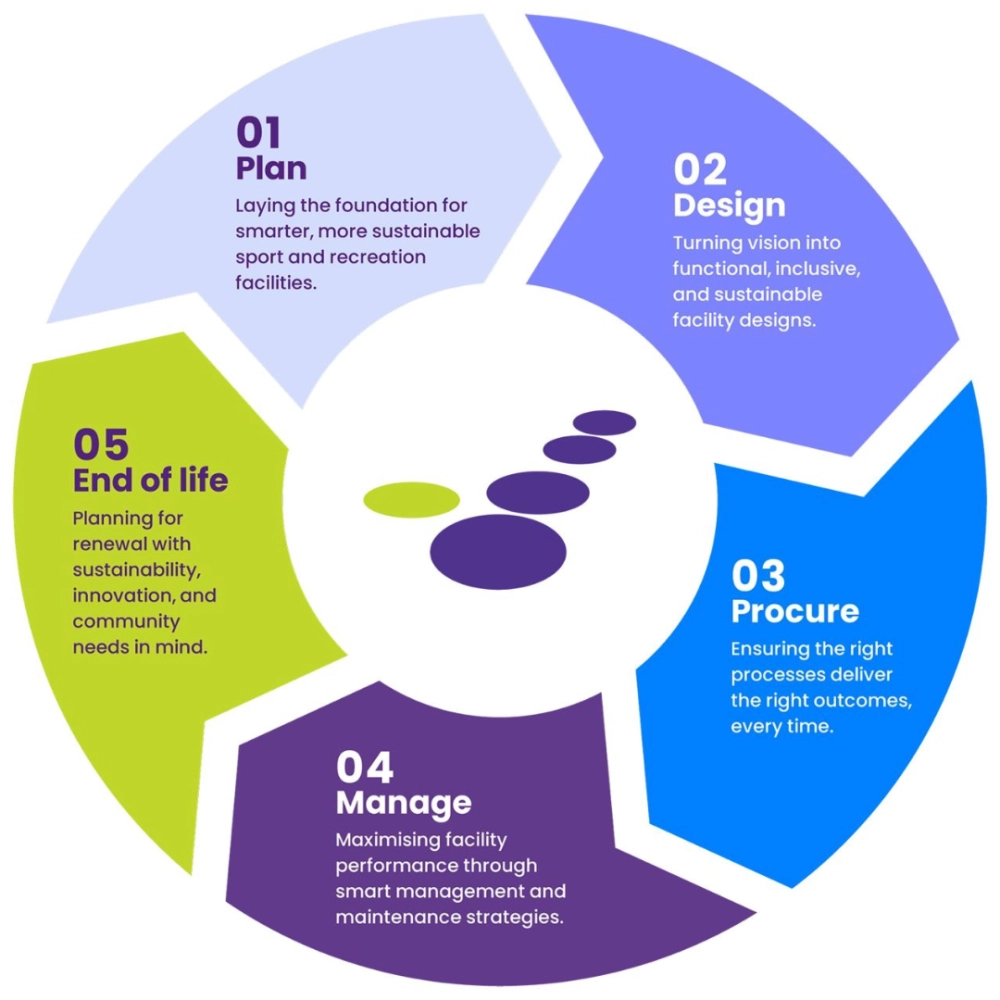
They will be the ones that can demonstrate how those objectives were embedded into design, procurement, construction and long-term asset management.
Environmental leadership is becoming much more practical.
Define the outcome.
Specify the requirement.
Ask for the evidence.
Verify the result.
And importantly, ensure that responsibility does not end at practical completion.
The environmental decisions made through design and procurement will influence how the surface is maintained, renewed and ultimately recovered at the end of its life.
Good procurement therefore does more than protect the project being delivered today. It establishes the conditions for responsible asset management for decades to come.
Planning or procuring a new sports surface?
Request SCC’s new Smart Insights on Global Regulations, Sports Surface Standards, PFAS and Microplastics.
Smart Connection Consulting can also support councils, sporting organisations and project teams with independent design review, specification development, procurement advice and tender evaluation.
Connect with me or contact Smart Connection Consulting before your project goes to market.
Smart Thinking provides evidence-based guidance for better sports surface planning, design, procurement and lifecycle decision-making. Explore SCC’s growing library of Smart Guides and Smart Insights at Smart Connection Consulting.