Planning resilient sports fields for conditions that no longer behave as expected
Sporting infrastructure is expected to perform for decades.
The playing surface may be renewed several times, but the pavement, drainage, lighting, landscape and supporting infrastructure can remain in place for 20 or 30 years, or longer.
Yet many projects are still being planned around historical assumptions about rainfall, heat, water availability and seasonal conditions.
Those assumptions are becoming less reliable.
Councils and sporting organisations are increasingly managing intense rainfall, flooding, prolonged dry periods, water restrictions, heatwaves, bushfire smoke, surface damage and disrupted participation.
These are often described as environmental challenges.
For sport, they are also operational, financial, health, participation and asset-management challenges.
A flooded field can mean cancelled fixtures, lost club revenue, displaced teams, infrastructure damage and higher maintenance costs.
An exposed sports precinct experiencing hotter conditions can affect player safety, spectator comfort, volunteer welfare, programming and whether people choose to use the facility at all.
Climate change is therefore not simply changing the environment around sport. It is changing the conditions under which sporting infrastructure must operate.
The question is no longer whether climate will affect a facility.
It is whether the facilities being planned today will remain safe, accessible, resilient and financially sustainable throughout their working life.
Climate resilience needs to begin before design
One of the patterns I continue to see is climate resilience being considered during design, if it is considered at all.
By then, many of the decisions that determine the project’s long-term resilience may already have been made:
- the site has been selected;
- the project scope has been defined;
- the funding application has been prepared;
- the preferred surface may already be assumed;
- and the available budget has been broadly established.
A design team may then be asked to incorporate improved drainage, additional shade, water-sensitive design or heat mitigation.
These measures can improve the outcome, but they may not correct a site or project concept that was poorly suited to the conditions surrounding it.
Climate resilience should influence the project from the initial needs assessment and options analysis through to the business case, site selection and project brief.
Before deciding which surface should be installed, decision-makers need to understand the environment in which the facility will operate.
That means asking:
- Is the site vulnerable to stormwater, waterway, coastal or groundwater flooding?
- How will more intense rainfall affect field drainage and downstream infrastructure?
- Is the precinct exposed to prolonged heat with limited shade or tree canopy?
- Will adequate water remain available for irrigation, landscaping or cooling?
- Are bushfire and air-quality events likely to interrupt use?
- Which soils, trees, waterways, habitats and drainage paths must be protected?
- How quickly must the facility return to play following extreme weather?
- What additional maintenance and renewal costs could changing conditions create?
These are not technical details to leave until construction documentation.
They are strategic planning questions that help determine whether the site, project concept and proposed investment are appropriate.
The field cannot be considered in isolation
A sports field sits within a wider system of soil, water, vegetation, paths, roads, buildings, car parks and drainage infrastructure.
Each element influences how the precinct responds to heat, rainfall, drought and flooding.
A synthetic sports field may provide greater carrying capacity and faster return to play during wet conditions than an overused natural turf field. However, that advantage only materialises when the whole hydraulic system performs.
Water must move through the carpet and infill, backing, shockpad, pavement and drainage network before reaching a suitable outlet or attenuation system.
A surface may appear permeable while water is being restricted or trapped deeper within the profile.
Poor drainage can contribute to:
- ponding;
- movement of lighter organic infill;
- uneven response underfoot;
- pavement instability;
- slower return to play;
- and premature deterioration.
Different forms of flooding also require different responses. A field designed to manage an intense local storm may still fail when a nearby waterway rises, an outlet is submerged or groundwater pushes upward through the pavement.
This is why drainage must be considered as part of the site and surrounding catchment – not simply as pipework beneath the field.
The same applies to heat.
The local microclimate is influenced by roads, roofs, buildings, car parks, paths, vegetation, shade and airflow, as well as the playing surface.
Some synthetic surfaces can become hotter than irrigated natural grass under direct sunlight, particularly older systems containing dark infill and surrounded by limited vegetation.
However, the local impact can be reduced through:
- appropriate site selection;
- lower-heat surface and infill systems;
- tree canopy and shaded rest areas;
- water-sensitive landscaping;
- reduced hardstand;
- and better treatment of the broader precinct.
The field matters, but the field is not the entire climate response.
From field-of-play planning to whole-of-park resilience
A climate-ready sporting facility should do more than withstand difficult conditions.
Where possible, it should help create a cooler, greener, more water-sensitive and ecologically connected community place.
That may include:
- protecting mature trees and existing ecological assets;
- expanding canopy around spectator, circulation and rest areas;
- harvesting water from the field and surrounding buildings;
- using captured water to support trees, landscape planting and natural turf;
- treating stormwater before it leaves the site;
- incorporating rain gardens, wetlands or other water-sensitive design;
- providing shaded connections between parking, public transport, pavilions and fields;
- reducing unnecessary hard surfaces;
- creating habitat corridors and native planting;
- and selecting durable, climate-responsive surface systems.
Not every project can deliver every outcome.
Site constraints, sporting requirements, budgets and existing infrastructure will always shape what is achieveable.
The important point is that these opportunities should be investigated deliberately rather than being added late, or overlooked entirely.
The strongest outcome is achieved when the field performs for sport while the surrounding parkland performs for nature, water, shade, community comfort and climate resilience.
SCC’s biodiversity guidance explains that the potential environmental value of a high-use synthetic field does not purely come from the surface itself. It may come from concentrating intensive activity onto a durable footprint while allowing surrounding land to better support tree canopy, habitat, stormwater management and passive recreation.
This is a more productive discussion than reducing every project to a simple natural-versus-synthetic debate.
Surface selection remains an options decision
Natural turf remains essential to community sport and will continue to be a popular solution in many locations.
When well planned, constructed, irrigated and maintained, it can provide high-quality playing conditions, cooling benefits and broader ecological value.
Hybrid turf may increase durability while retaining many of the qualities of a natural surface.
Synthetic technology may be appropriate where usage demand, land constraints, wet-weather availability, maintenance conditions or sport-specific performance needs exceed what natural turf can reliably accommodate.
The planning mistake is not choosing one particular surface type.
The mistake is assuming the answer before the need, site and operating conditions have been properly assessed.
A climate-resilient options assessment should consider:
Demand and carrying capacity
- How many hours of structured sport, school use, community activity and informal recreation need to be accommodated?
Climate exposure
- What heat, rainfall, flood, drought, water, wind and bushfire conditions is the facility likely to experience?
Performance requirements
- Which sports, standards of play, participant groups and safety outcomes must the facility support?
Site and environmental conditions
- What soils, drainage paths, trees, waterways, habitats and surrounding uses need to be protected or improved?
Maintenance capability
- Does the asset owner have the resources, equipment, expertise and budget required to manage the selected solution?
Whole-of-life cost
- What will the facility cost to construct, maintain, monitor, operate and renew?
Environmental opportunity
- Can the project improve water management, canopy, biodiversity, circularity and the performance of the wider parkland?
The SCC Sports Surface Self-Assessment reinforces the need to examine site suitability, flooding, sensitive environments, tree management, water harvesting, drainage, surface demand, maintenance responsibility and replacement funding during planning.
This is where an effective business case is created.
Not by beginning with a preferred product, but by establishing the need and assessing the available solutions against the conditions the asset will actually face.
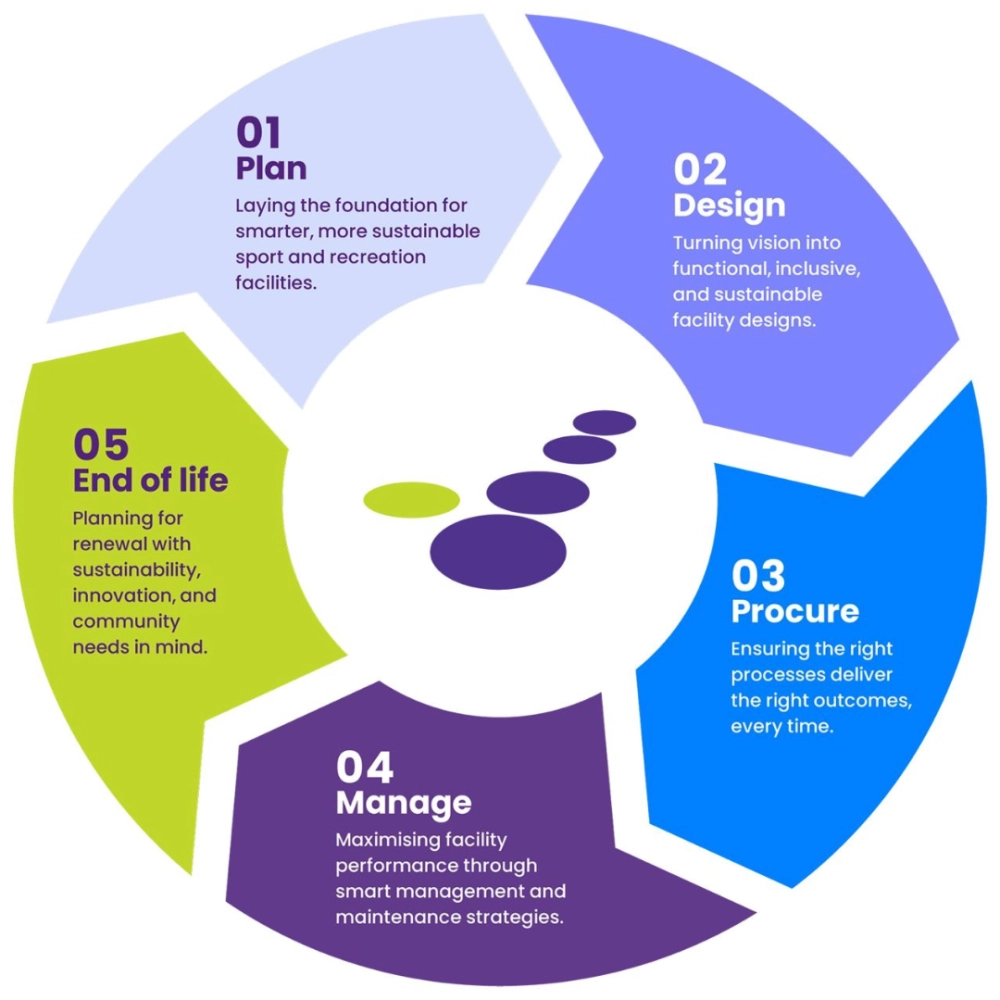
Climate resilience across the SCC five-phase lifecycle
Climate resilience cannot be resolved through one design feature or one stage of a project.
It must remain visible across the entire lifecycle.
Plan – Understand demand, climate exposure, site suitability, flood risk, climate, water availability, ecological value and whole-of-park opportunities before committing to a solution.
Design – Treat the field, drainage, landscape and surrounding infrastructure as one connected system. Address shade, canopy, water harvesting, stormwater treatment, surface temperature, containment and participant comfort.
Procure – Translate environmental and climate objectives into measurable requirements. Require evidence of performance, durability, drainage capacity, material composition, maintenance needs and suitability for local conditions.
Manage – Maintain the surface and surrounding assets, including drainage, filters, edges, vegetation and shade. Record closures, flood events, heat impacts, maintenance activity and changes in performance.or disassembly, reuse and recycling. Require evidence of processing so the surface does not become a future waste or pollution burden.
End of Life – Plan renewal before deterioration becomes critical. Retain pavement, drainage and shockpad infrastructure where it remains suitable, and establish verified recovery pathways for materials being removed.
Climate resilience is not something that can be checked off once.
It is an ongoing asset stewardship responsibility.
Seven questions to ask before progressing
For councils, sports and facility owners preparing a new field or renewal project, I would encourage seven early questions:
- What conditions is this facility likely to experience over the next 20 to 30 years?
- Is the proposed site appropriate for those conditions?
- Have natural, hybrid and synthetic options been assessed against actual demand?
- How will the whole park manage climate changes, water, shade, biodiversity and community access?
- What climate, drainage and environmental outcomes need to be specified?
- Who will maintain and monitor the asset, and is that responsibility adequately funded?
- How will the facility and its individual components be renewed or recovered?
If these questions cannot yet be answered, the project may not be ready to progress into detailed design or procurement.
That is not a reason to stop.
It is a reason to strengthen the planning.
A New Smart Insight: Climate Change and Sport
To support better planning, Smart Connection Consulting has released a new Climate Change and Sport Smart Insight.
The resource explores how extreme heat, drought, intense rainfall, flooding, storms, poor air quality and biodiversity decline are affecting sporting participation and infrastructure.
It also outlines practical responses, including:
- climate-responsive site planning;
- water-sensitive design;
- shade and tree canopy;
- resilient materials;
- integrated drainage;
- and whole-of-life asset management.
It forms part of SCC’s growing Smart Insight library, alongside related guidance on:
- Drainage for Synthetic Sports Fields
- Urban Heat Island Impact
- Designing Synthetic Sports Fields for Biodiversity
- Environmental Impact Opportunities
These resources are designed to help councils, sporting organisations, schools, planners and project teams understand the issues, ask more intentional questions and identify where specialist advice may be required.
Planning for the conditions ahead
The facilities being planned today will serve communities for a generation.
We cannot design them only for the climate patterns, usage expectations and operating conditions we have known in the past.
We need to plan for the conditions the asset is likely to face throughout its life.
That requires earlier investigation, stronger site assessment, transparent options analysis and a whole-of-park approach connecting sport, water, nature, climate and community use.
Climate resilience should not be added after the important decisions have already been made.
It should help shape those decisions from the beginning.
Because the best time to create a resilient sports facility is not once construction has commenced.
It is when the first planning questions are being asked.
Are you planning, upgrading or renewing a sports field?
Request SCC’s new Climate Change and Sport Smart Insight, together with supporting guidance on drainage, urban heat and biodiversity.
Smart Connection Consulting can also assist councils, sporting organisations and project teams with early planning, site and options assessments, business cases, lifecycle strategies and independent sports surface advice.
Connect with me directly, or contact Smart Connection Consulting before the project’s key planning decisions are locked in.